US Arrests Malians in Terror Drugs “Link”
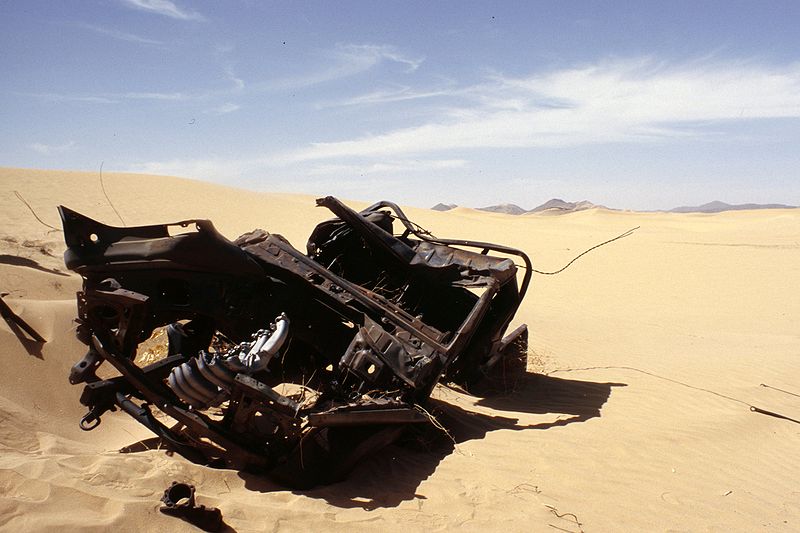 The Saharan Al Qaeda – Cocaine has finally hit the North American domestic news with the much trumpeted arrest by United States agents of three Malians who they allege “the direct link between dangerous terrorist organizations, including Al Qaeda, and international drug trafficking that fuels their violent activities”.
I have a feeling we’ll be repeatedly discussing these arrests in the future. But at first blush these men are likely not involved in the large scale West African drug trade that has recently been in the papers, nor are they any part of any recognized AQIM groups connected to Algerian militants scattered in the Malian Sahara.
Admittedly we have very little to go on at the moment. Three Malian men, said to be in their mid 30s, were arrested by the US in Ghana, and flown to New York. Here they were disposed before a judge on drug smuggling and terrorism charges. We have the New York Times and wire articles, based entirely on the press release and a copy of the actual deposition provided by the US government. I await the reaction of the Malian press especially.
Aminatou update

[UPDATE: yeah. Haidar back in El Aaiun & passed customs w/o passport, on Spanish papers]
Short update on the Aminatou Haidar stalemate, which may be about to finally resolve itself one way or the other:
- AFP reports that she was taken to intensive care earlier today, reportedly after vomiting blood.
- Whether related or not, Morocco just caved, according to multiple sources, incl. Reuters, which has POLISARIO jumping on cue into the spotlight:
“Effectively everything has been resolved, according to our information,” said Ibrahim Ghali, the POLISARIO ambassador to Algeria, where the movement has its HQ. “A plane is at Lanzarote airport awaiting instructions,” he told Reuters.
Guess we’ll have to wait and see if this turns out to be true: recall that an earlier attempt to fly her back ended when Morocco changed its mind and refused landing permission. Fassi Fihri recently met with Ban Ki-moon, so they might want to put a UN stamp on her return, to help Rabat save face internally. Not that it will look good for the government anyway, but they really got themselves into that dead end. M6 should consider expelling some of his media advisors instead.
Also, pour les French speakers, Ibn Kafka has a series of interesting posts (1, 2, 3) discussing the legality of the expulsion and nationality issue, from an anti-independence but pro-rule-of-law Moroccan standpoint.
The Algerian Jews
Houwari at Algerian Review (great new blog!) has an interesting post up about the Algerian Jewish community. Below are some of my own reflections on the matter.
Niger’s 6th Republic stumbles on, looking for the door
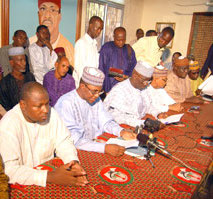
"Baba Tandja" looms over the MNSD-Nassara leadership.
No end is yet in sight for the Nigerien political crisis, begun when President Tandja Mamadou, facing the end of his term-limited mandate on 22 December, decided to scrap the constitution of the 5th Republic, and grant himself three years grace period in which to create a 6th Republic. The alienation of most of the political class was expected, but the severity of ECOWAS rhetoric was likely not. Niger’s rulers would have expected this to be wrapped up by now, with the previous legal deadline for a new president to pass with a shrug. But the personal interest of current ECOWAS chair Nigeria — Niger’s massive neighbor and largest African trade partner — has meant that President Tandja has been excluded from the body, branded as a coup leader, and placed alongside Capt. Moussa Dadis Camara as a poster child for what’s wrong with West African governance.
And while Blaise Compaore, assigned mediation duties in Guinea, seems intent on finding a way for Dadis to stay in power despite his wholesale slaughter of his own people, Yar’Adua’s government has kept an unusual concentration of pressure on Niamey. [see Niger:Piling on the Pressure for details] Sadly, this has far exceeded any pressure the remarkably unified internal opposition has been able to bring to bear internally.
Should effective ECOWAS pressure escalate as they promise, seconded by sanctions by crucial donors like France, the EU, and the US, Niger’s new 6th Republic can’t carry on indefinitely. Current Chinese projects don’t fill the gap with direct payments. While uranium and oil revenue continue to flood in, too much of that has gone to support a small group of businessmen around Tandja to enable the government to balance the budget with it. Wages will not be paid, loans will not be forthcoming, the military will miss their trips to Fréjus, and there will be trouble.
But if Tandja is toppled or forced to give way in this manner, it will be an inside job by the political and military leadership who aided his new constitutional order.
Morocco vs. Aminatou

A hunger strike in Lanzarote is turning into a serious crisis in and between Spain and Morocco. Center stage is occupied by Western Saharan human rights leader and pro-independence activist Aminatou Haidar. This former prisoner-of-conscience, “desaparecido”, and mother of two, has been a major name in Sahrawi politics since May 2005, when a picture of her smashed into a pulp by Moroccan police officers went viral, as the kids say, among Sahrawi activists. The photo of her in her blood-drenched melhfa became, for them, the first iconic image of the Sahrawi independence struggle, waved as both memento of Moroccan cruelty and as a stand-in for the banned flag. To add insult to injury, she was jailed after the abuse, but eventually released after heavy foreign pressure. Displaying a rather remarkable steel in her spine — whatever you think of her politics, there’s no doubting her courage — she’s been charging in a one-woman full frontal assault ever since, campaigning publicly and frequently meeting foreign politicians and the press, in what seems to be a deliberate gamble to raise her profile and make her untouchable. So far, it’s been working all right. She’s been monitored, harassed, made unemployable and had her family placed under perpetual pressure, but the government hasn’t really had the stomach to touch her personally again since HRW and Amnesty aimed their spotlights at her; remember that Morocco’s overarching strategy is to keep the Saharan front as quiet as possible.
Algeria eating itself
 At `Aqoul, The Lounsbury has a great post up on an expected takeover of Djezzy, a huge cell phone operator owned by Orascom (an Egyptian firm) which led the telecom revolution in Algeria. A French company has teamed up with two businesses each representing a slice of the Algerian elite: Cevital (local business giant Issad Rebrab’s all-purpose corporation) and Sonatrach (the state oil company, a.k.a. the ATM of the pouvoir) to push out the Egyptians. That’s the sad state of Algeria for you: a giant, violent redistributory machine, moving capital from productive sectors of society to Swiss bank accounts.
Not that I feel much sympathy for Orascom’s owners, crooks as they undoubtedly are too, but it seems to me one more sign that the just-recently moderately promising outlook for Algeria is dimming fast. At this stage, Bouteflika appears to have more or less given up on liberalizing the economy, to leave the country on a positive trajectory. And I think that’s what he will be remembered for: unexpectedly and brilliantly centralizing power, partly through fortifying the rentier state, only to then miss the opportunity to use all that power to transform the country. Sooner or later, the old man will die, and there will be no one (?) there to catch the reins except the officers and their civilian props, all jostling for sole possession — and back we are to square one.
The Algerian press & mass-market reach
 I don’t have time to get into any detail here, or to find comparable up-to-date figures, but I’d just like to throw you a thought that has been with me for a while, which I hope someone more competent may carry further. Here’s what the European Journalism Centre has to say about Algeria’s printed-press landscape:
Algeria has about 50 daily or weekly publications. Most of them circulate 15.000 copies, roughly estimated. Only four newspapers are estimated to boast circulation greater than 50.000 copies: Arabic- language El Khabar (530.000); Le Quotidien d’Oran (140.000-198.000) Liberté (120.000- 150.000) and El-Watan (70.000-90.000) in French.
Mauritanian kidnappings
Three Spaniards snatched from an aid convoy, in an unpleasant first for Mauritania. Details remain scarce, but you’ll find an informative post and a useful discussion at the Sahel Blog.
Swiss minaret ban
Not Maghreb related per se, but one can’t just let this pass without comment:
Frankfurt – In what many see as a major setback to Europe’s effort to integrate its booming Muslim population – and a potential boost to right-wing parties throughout the continent – Swiss voters Sunday approved a move to ban the construction of new minarets in the country.
The Swiss government had urged voters to reject the ban, saying that it would violate religious freedom and human rights and intensify Islamic radicalism. But in Sunday’s referendum, which was organized by a right-wing political party, more than 57 percent of Swiss residents – a majority in 22 out of the country’s 26’s cantons – approved the proposal.
 On the other hand, there’s not really a lot you can say about it either, except that this shouldn’t be taken as some minor aberration. For several years, parts of the Europen political landscape (not to mention the US Republican fringe, which is even loonier, but there are stronger constitutional safeguards there) has been sliding into clear-cut Islamophobic territory. Jew-bashing and other classic gimmicks are now a thing of the past: most far-right populists embrace Israel as a “Western outpost”, claim to have no racial prejudices, and now spend their days almost exclusively targeting Muslims, not on account of their religion, but because of what they call “Islam’s ideology”.
Of course it’s nonsense — they’re bigots, and that’s that. We’ve seen these people before, and apparently didn’t deal firmly enough with them in 1945, so here they are again. The new rhetoric seems to work like a charm, too, no matter how irrational their arguments (“‘Muslims don’t just practice religion, they increasingly make political and legal demands,’ said Walter Wobmann, who heads the initiative behind the referendum“), certainly helped along by their similarly bigoted counterparts in the Muslim world, and even more, I’m sure, by the social tensions raised by the economic crisis .
Conditions vary from country to country, of course — there’s no such thing as a “European debate”, whatever the EU may accomplish in the future — but the general trend is quite clear. Until recently, there was much beating around the bush, and talk about how it’s not really about hating Muslims, it’s just about fighting terrorism and supporting womens’ rights, and adopting a responsible immigration policy. Again, nonsense.
Now, the stage has been set, and here we go: Switzerland has actually voted for a law specifically and openly aimed at Muslims as a religious minority. The gloves are coming off, and this could get considerably worse in years to come.
As for me, I now count myself among the backers of Col. Qadhafi’s Great Popular De-Swissification Plan.
“Letter from a Sahrawi friend”
Quick translation of an interesting editorial in Morocco’s outspoken weekly Le Journal hebdomadaire, in the form of a fictive letter from a “Sahrawi friend” describing how his cost/benefit analysis of Western Saharan independence is shifting. Shorter version: the present regime in Morocco can’t win Sahrawi hearts and minds.


 Maghreb Politics Review